
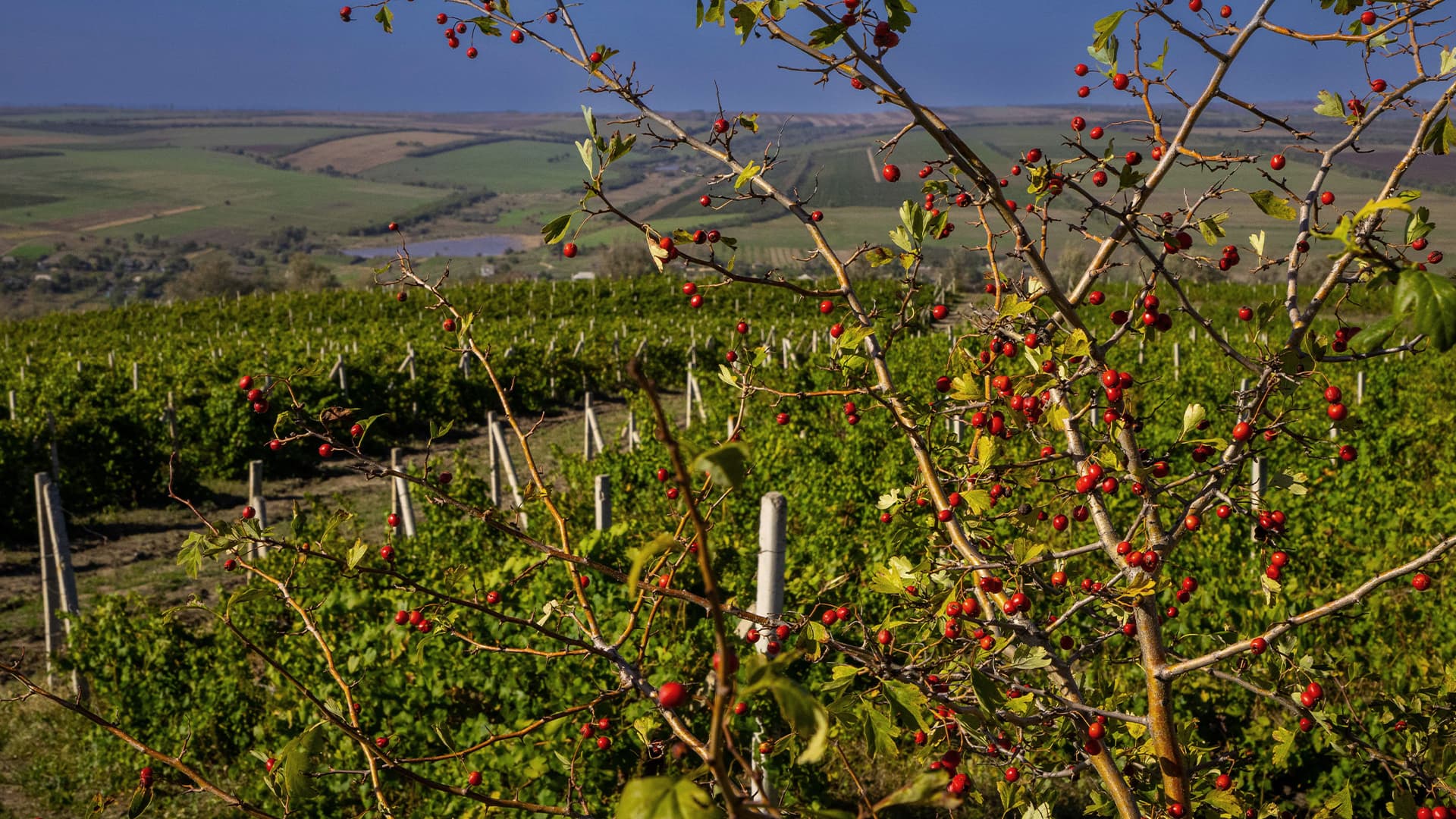
Located in the Valul lui Traian wine region, the vineyards of Dulgher Family Estate benefit from a moderately continental climate, influenced by the hydrological corridor of the Prut River, the proximity of the Danube, and the moderating effects extending from the Black Sea. Situated at approximately 46–47° north latitude, the vineyards lie within the same northern European belt of quality viticulture that includes Burgundy and Chablis—a zone where abundant sunlight, strong diurnal temperature variations, and a long growing season compensate for the relatively high latitude through precision and balance. These conditions allow for the full ripening of both white and red varieties, while preserving the freshness and acidity that define great wines.
Climatic data from the Valul lui Traian region confirm the exceptional viticultural vocation of this territory. The average annual temperature ranges between 9.5 and 10°C, with long, sufficiently warm summers that allow for the full ripening of a wide range of grape varieties. The growing season, spanning 179–187 days with temperatures above 10°C, enables a slow and balanced evolution of the grapes, while 310–320 sunny days per year promote the accumulation of aromatic and phenolic compounds. With annual precipitation between 450 and 550 mm, the region falls within a moderately dry hydric regime, considered ideal for quality viticulture. This balance of heat, light, and water availability corresponds to the classical parameters of great wine regions and contributes to wines characterized by concentration, aromatic expression, and aging potential.
Regarding soils, Romanovca and Filipeni are located in the heart of the vast Eurasian chernozem belt, one of the most fertile soil formations in the world, stretching from the Pannonian Basin to the southern steppes of Kazakhstan. In viticulture, excessive fertility is not always an advantage—great wines are born in soils that naturally limit productivity and force the vine to concentrate its resources in the fruit.
In Romanovca and Filipeni, this balance is shaped by calcareous chernozem soils and the natural sculpting of the landscape through erosion. Active calcium carbonate in the soil profile moderates vine vigor and encourages deep root development, while moderate erosion limits surface water and nutrient reserves.
In Romanovca and Filipeni, this balance is shaped by calcareous chernozem soils and the natural sculpting of the landscape through erosion. Active calcium carbonate in the soil profile moderates vine vigor and encourages deep root development, while moderate erosion limits surface water and nutrient reserves.